

Have you ever found yourself saying, “I can hear you but I just can’t understand what you’re saying”?
Maybe you can hear someone talking from across the room, but their words seem muffled or unclear. You may hear the television perfectly well but have trouble following the dialogue. Or perhaps one-on-one conversations are relatively easy, while understanding someone in a busy restaurant feels nearly impossible.
If you can hear but can’t understand words, it doesn’t necessarily mean people are mumbling or that the TV needs to be louder. Difficulty understanding speech can be an important sign of hearing loss, particularly when the problem involves certain frequencies or your ability to distinguish speech sounds.
Understanding why this happens starts with recognizing an important distinction: hearing sound and understanding speech are not the same thing.
Why Can I Hear but Not Understand What People Are Saying?
Hearing isn’t simply a matter of whether a sound is loud enough.
Human speech contains a complex combination of sounds at different frequencies. Some speech sounds provide much of the volume we perceive, while others provide important details that allow us to distinguish one word from another.
This means you may be able to tell that someone is talking while missing enough pieces of the speech signal that you have difficulty understanding speech.
Instead of hearing a complete sentence clearly, your brain may receive incomplete information and have to fill in the gaps using context.
That’s one reason people with hearing loss sometimes say:
- “Everyone seems to mumble.”
- “I hear people, but I don’t understand them.”
- “I can hear the TV, but I can’t make out the dialogue.”
- “I do fine one-on-one, but I can’t understand conversations in groups.”
- “I hear some people much better than others.”
These experiences can be signs that speech clarity—not simply volume—is becoming a problem.
Hearing and Understanding Aren’t the Same Thing
Think of hearing a conversation as a two-part process.
First, your auditory system has to detect the sounds. Then, your brain has to interpret those sounds and turn them into meaningful language.
That’s why increasing volume isn’t always enough to make speech clearer.
Imagine listening to a radio station with poor reception. Turning up the volume makes the sound louder, but it doesn’t necessarily make the signal clearer. If parts of the signal are missing or distorted, you’re essentially making an incomplete signal louder.
Something similar can happen with hearing loss.
You may still detect someone’s voice while missing some of the acoustic information needed to distinguish individual words.
How Your Ears and Brain Work Together to Understand Speech
Speech understanding begins in the ears, but it doesn’t end there.
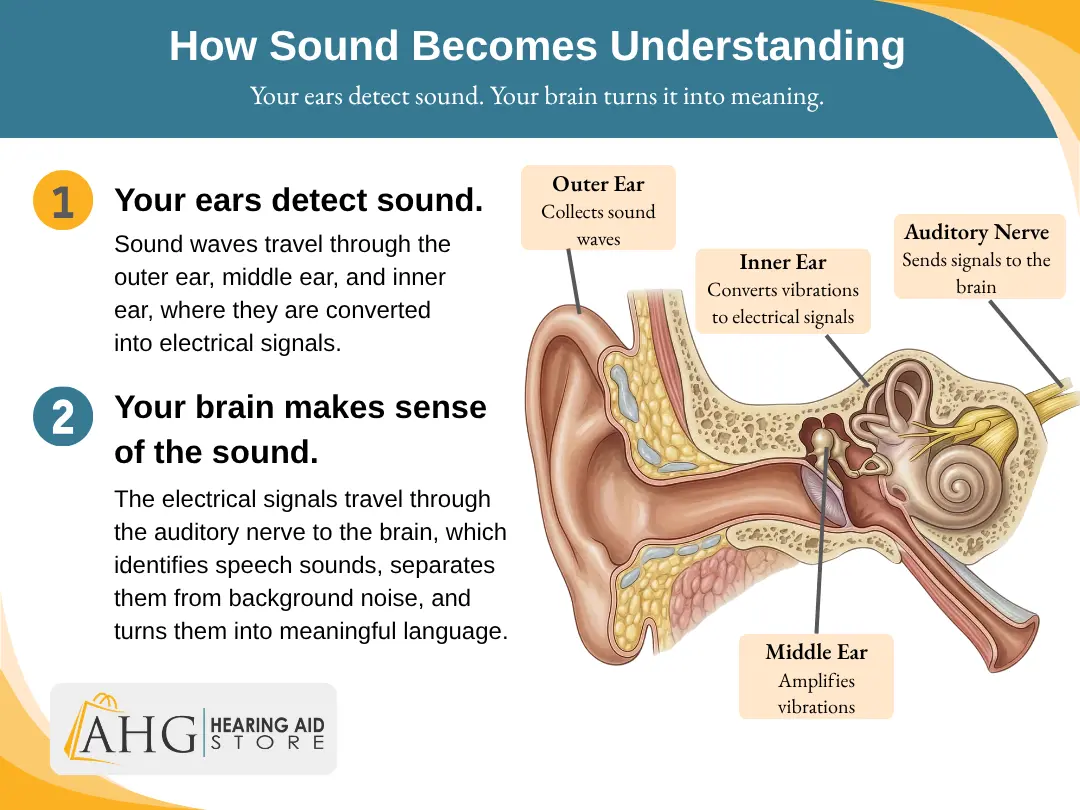
Sound waves travel through the outer ear and cause the eardrum to vibrate. Those vibrations are transmitted through the tiny bones of the middle ear to the cochlea in the inner ear.
Inside the cochlea are sensory hair cells that help convert sound vibrations into electrical signals. Those signals travel along the auditory nerve to the brain, where they are processed and interpreted.
Your brain then performs an impressive amount of work. It identifies speech sounds, separates a person’s voice from competing sounds, recognizes words and uses context to determine meaning.
When the auditory system isn’t delivering a complete signal, the brain has less information to work with.
This can contribute to a frustrating situation where you hear but can’t understand speech clearly.
Why Some Types of Hearing Loss Affect Clarity More Than Volume
One common reason someone can hear voices but struggle to understand words is high-frequency hearing loss.
Many important consonant sounds occur at higher frequencies. Sounds such as “s,” “f,” “th,” “sh,” “t” and “k” help provide clarity and distinguish similar words.
Lower-frequency vowel sounds often carry more of the perceived volume of speech.
If your hearing is better in lower frequencies but reduced in higher frequencies, you may still hear that someone is talking because you detect much of the louder portion of their voice. But you may miss some of the quieter consonants that make words distinct.
As a simplified example, words such as “cat,” “cap” and “cash” contain similar vowel information but are distinguished by consonants.
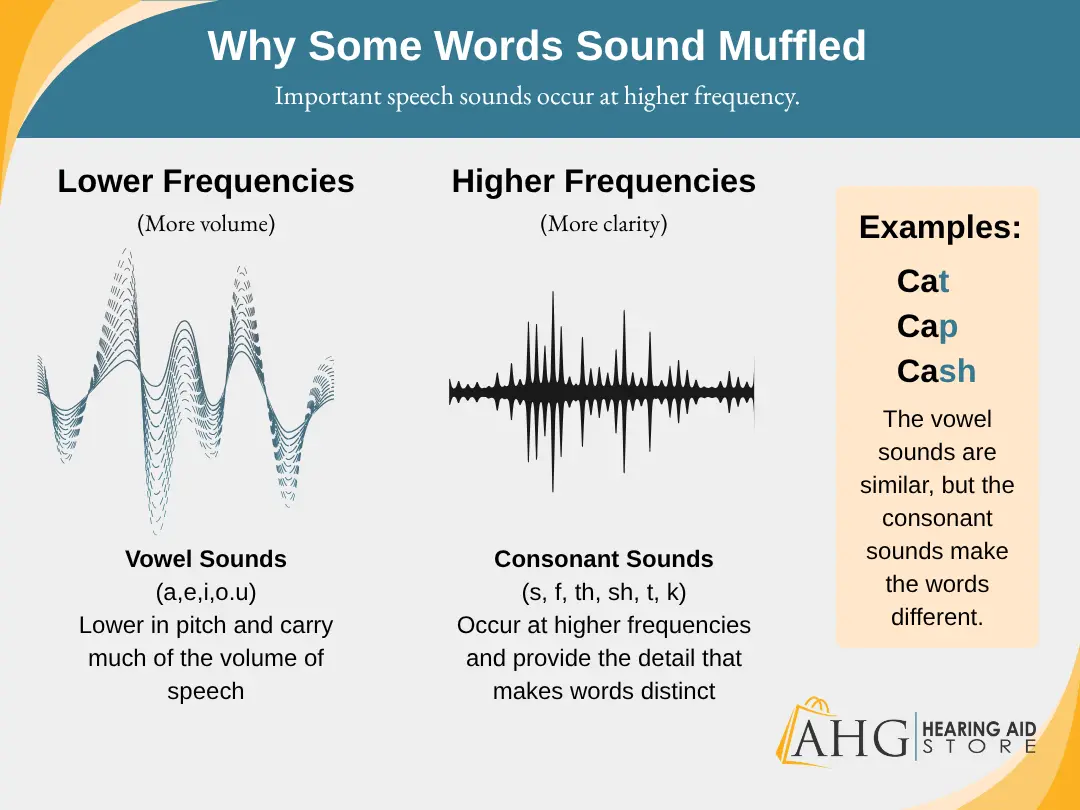
Missing those details can make conversations seem muffled or unclear even when they seem loud enough.
This is why speech clarity hearing loss can be so confusing. The issue may not feel like an inability to hear. Instead, it can feel like everyone around you has suddenly started mumbling.
Why Is Understanding Speech So Much Harder in Background Noise?
Restaurants, family gatherings, meetings, parties and other noisy environments create an additional challenge.
In a quiet room, your auditory system has a relatively clean speech signal to process. Add music, dishes clattering, HVAC noise and several other conversations, and your brain suddenly has to determine which sounds deserve attention.
People with normal hearing generally have an easier time separating the voice they want to hear from competing sounds.
Hearing loss can make that task significantly more difficult.
If portions of the speech signal are already reduced, background noise can mask additional information. Your brain has fewer clues available to distinguish the person speaking from everything happening around them.
You may consequently notice that:
- One-on-one conversations in quiet places are relatively easy.
- Group conversations require much more concentration.
- Restaurants are particularly difficult.
- You frequently ask people to repeat themselves.
- You understand better when you can see the speaker’s face.
- Conversations leave you feeling mentally tired.
Difficulty hearing in background noise can be an important reason to have your hearing professionally evaluated—even if you feel you can hear relatively well in quiet environments.
Why Turning Up the TV Doesn’t Always Help
TV dialogue is often one of the first places people notice a problem with speech understanding.
The natural response is to reach for the remote.
Sometimes additional volume helps. But if the underlying issue involves your ability to hear particular speech frequencies or distinguish speech sounds, turning up the television may make everything louder without making dialogue proportionately clearer.
Background music, sound effects and other noises get louder too.
You may find yourself continually increasing the volume but still missing certain words.
Other members of the household may even complain that the TV is excessively loud while you’re still struggling to follow the dialogue.
When that happens regularly, the issue may be less about television volume and more about how you’re hearing and processing speech.
Why a Hearing Test Measures More Than How Quietly You Can Hear
Many people imagine a hearing test as simply listening for a series of beeps and pressing a button whenever they hear one.
That’s part of a comprehensive hearing evaluation, but it isn’t the entire picture.

Pure-tone testing helps determine the softest sounds you can hear across different frequencies. The results can help an audiologist determine whether hearing loss is present and, if so, its type, degree and configuration.
But understanding speech involves more than detecting tones.
A hearing evaluation may also include testing designed to assess your ability to recognize and understand speech. Depending on your needs and the testing performed, this can provide additional information about hearing loss and speech recognition.
This distinction matters.
Two people may have seemingly similar difficulty detecting sounds but experience very different levels of speech understanding.
That’s one reason a professional hearing evaluation can provide much more useful information than simply determining whether you can hear a particular sound.
Can Hearing Aids Improve Speech Understanding?
For many people with hearing loss, appropriately selected and programmed hearing aids can make speech easier to hear and understand.
Modern hearing aids don’t simply make every sound equally louder. Depending on the technology and programming, they can be configured according to an individual’s hearing needs and may include features designed to improve access to speech and manage competing noise.
Potential features can include:
- Directional microphones
- Digital noise reduction
- Automatic listening programs
- Speech-focused processing
- Multiple listening environments
- Bluetooth and wireless connectivity
However, hearing aids aren’t a universal guarantee of perfect speech understanding.
Results depend on factors including the type and degree of hearing loss, speech-recognition ability, listening environment, hearing aid fitting and programming, and individual auditory needs.
Your brain may also need time to become accustomed to hearing sounds that it hasn’t heard clearly for some time.
That’s one reason professional evaluation, fitting and follow-up care can be so valuable. An audiologist can evaluate your hearing, discuss realistic expectations and determine which hearing solutions may be appropriate for your individual needs.
When Should You Schedule a Professional Hearing Evaluation?
Occasionally missing a word doesn’t automatically mean you have hearing loss. Everyone has trouble understanding speech from time to time, particularly when someone speaks quietly or there’s a lot of background noise.
However, consider scheduling a hearing evaluation if you regularly:
- Can hear people talking but can’t understand what they’re saying
- Think people are mumbling
- Have trouble understanding conversations in restaurants or groups
- Frequently ask people to repeat themselves
- Turn the television up higher than other people prefer
- Have difficulty understanding higher-pitched voices
- Misunderstand similar-sounding words
- Depend on seeing someone’s face to understand them
- Avoid conversations or social situations because hearing is difficult
A comprehensive evaluation can help determine whether hearing loss is contributing to the problem and what options may be appropriate.
FAQs About Hearing Speech but Not Understanding Words
Why can I hear someone talking but not understand the words?
Hearing a voice and understanding speech require different types of auditory information. You may detect enough sound to know that someone is speaking while missing some of the frequencies or speech cues needed to distinguish individual words. A hearing evaluation can help identify whether hearing loss is contributing to the problem.
Does everyone mumbling mean I have hearing loss?
People certainly do mumble sometimes, but if everyone seems to be mumbling—especially if this is a relatively new or worsening problem—it may be worth having your hearing checked. Hearing loss affecting certain frequencies can make otherwise clear speech sound muffled.
Why can I understand people in quiet places but not restaurants?
Background noise creates competing auditory information. Your auditory system and brain have to separate the voice you’re trying to hear from surrounding conversations and other sounds. Hearing loss can make this process more difficult.
Why can I hear the TV but not understand what people are saying?
Television dialogue contains a mixture of speech frequencies, while music, sound effects and background noise may compete with the dialogue. If hearing loss affects some of the frequencies important for speech clarity, making the TV louder may not restore all of the missing information.
Is difficulty understanding speech a sign of hearing loss?
It can be. Difficulty understanding conversations is a common reason people seek a hearing evaluation. However, there can be different reasons for speech-understanding problems, so a professional evaluation is important rather than assuming hearing aids are automatically the solution.
Can high-frequency hearing loss make people sound like they’re mumbling?
Yes. High-frequency hearing loss can reduce access to some consonant sounds that provide important details for understanding words. You may still hear the lower-frequency portions of someone’s voice while missing some of the information that makes speech clear.
Will hearing aids make speech perfectly clear again?
Hearing aids can improve access to sounds and speech for many people with hearing loss, but outcomes vary. The type and degree of hearing loss, speech-recognition ability, listening environment, hearing-aid technology, fitting and programming can all influence results.
Should I get my hearing tested even if I can still hear?
Yes. Hearing loss isn’t necessarily an all-or-nothing inability to hear. You can hear many sounds and still have hearing loss in particular frequencies or difficulty understanding speech. A comprehensive hearing evaluation can provide a much clearer picture of your hearing ability.
Stop Guessing Why Conversations Are Becoming Difficult—Schedule a Hearing Evaluation Today
Struggling to follow conversations can be frustrating, especially when you know you can hear people talking. But simply increasing the volume isn’t always the answer.
Finding out why speech isn’t clear is the first step toward determining what may help.
If you’re hearing sounds but struggling to understand conversations, schedule a comprehensive hearing evaluation with Advanced Hearing Group to find out why.
Our experienced hearing professionals can evaluate your hearing and speech understanding, explain your results and help you explore appropriate solutions—including professionally fitted hearing aids when indicated.
Schedule an appointment with our audiologists today and take the first step toward clearer, easier conversations.