You’ve invested in hearing aids to hear conversations more clearly, stay connected with loved ones, and enjoy everyday sounds. But how do you know whether your hearing aids are actually delivering the amplification you need?
Just because your hearing aids turn on, make sounds louder, and feel comfortable doesn’t necessarily mean they’re working as effectively as they could.
That’s where real ear measurements come in.
Real ear measurements (REM) are an important part of professional hearing aid verification. They allow an audiologist to measure how much sound your hearing aids deliver inside your ear canals. Then, they can determine whether that amplification matches your individual hearing prescription.
Unlike simply turning up the volume or relying on factory-programmed settings, this evidence-based approach helps ensure that your hearing aids are appropriately adjusted for your unique hearing needs.
Let’s explore how audiologists use real ear measurements, what the results reveal, and why professional verification and ongoing audiology care offer important advantages over purchasing hearing aids without professional support.
What Are Real Ear Measurements and Why Do They Matter?
Real ear measurements are objective tests that audiologists use to verify how hearing aids amplify sound inside your ears. The measurements help determine whether the devices provide appropriate amplification at different frequencies and listening levels.
You may also hear this process called:
- Real Ear Measurement (REM)
- Real ear verification
- Probe microphone measurement
- Hearing aid verification
Why is this testing necessary?
Because everyone’s ears are different.
The size and shape of your ear canals, the way your hearing aids fit, and your individual hearing loss can all affect how sound reaches your eardrums.
Even two people with similar hearing test results may experience different levels of amplification from the same hearing aid model.
Hearing aid manufacturers use sophisticated software to estimate appropriate settings based on hearing test results. However, those estimates don’t always perfectly match the sound delivered inside an individual’s ears.
Real ear measurements allow audiologists to check actual hearing aid performance instead of relying on predictions alone.
For a closer look at the technology and testing procedure, read What Is Real Ear Measurement and Why Is It Important for Hearing Aid Fittings?
How Do Audiologists Know Whether Your Hearing Aids Are Working Properly?
An audiologist doesn’t have to guess whether your hearing aids are providing enough amplification.
During a professional hearing aid fitting, several types of information can be used to evaluate hearing aid performance.
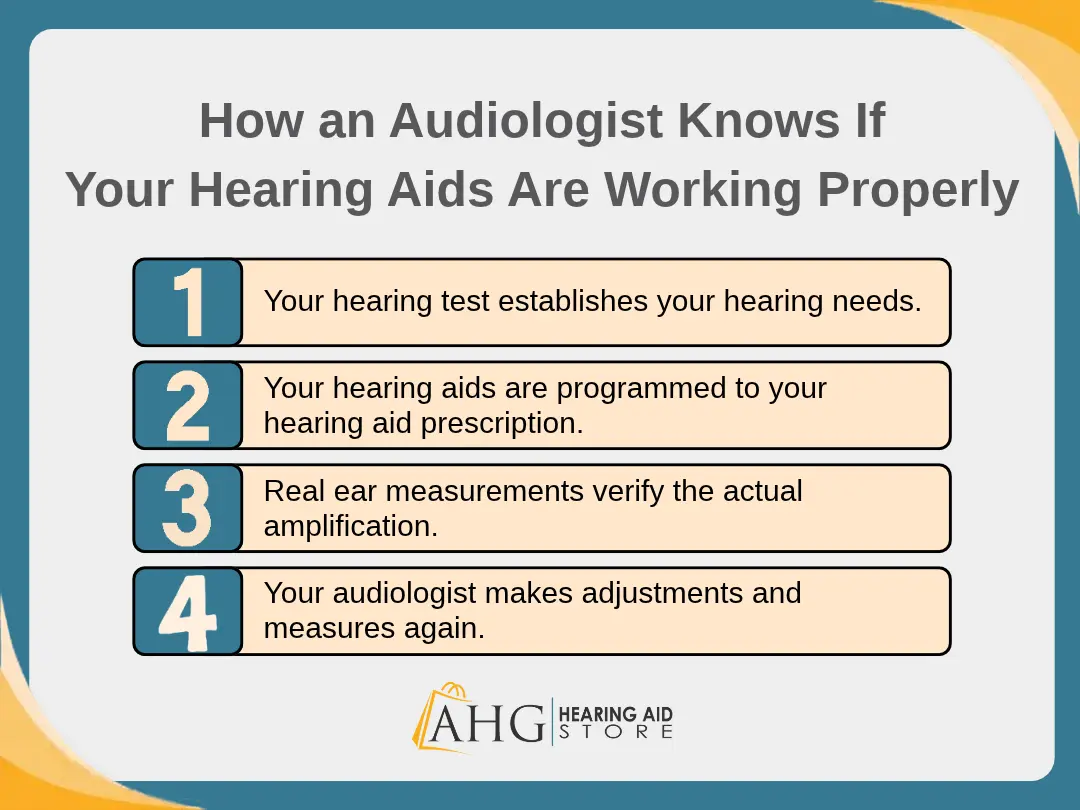
1. Your Hearing Test Establishes Your Hearing Needs
The process begins with a comprehensive hearing evaluation.
Your audiologist measures how well you hear different pitches and sound levels, creating an audiogram that illustrates your hearing abilities.
These results help determine which frequencies require additional amplification.
For example, you may hear lower-pitched sounds relatively well but struggle with higher-frequency consonants that are important for understanding speech.
Your hearing aids need to address those specific difficulties rather than simply making everything louder.
2. Your Hearing Aids Are Programmed to Your Hearing Prescription
Using specialized fitting software, your audiologist programs your hearing aids according to your hearing test results and an established prescriptive fitting formula.
The software calculates appropriate amplification targets for different frequencies and sound levels.
However, initial programming is only a starting point.
The software predicts how your hearing aids should perform, but it doesn’t necessarily confirm what actually happens inside your ears.
3. Real Ear Measurements Verify the Actual Amplification
During real ear measurement testing, your audiologist places a thin probe microphone tube inside your ear canal alongside your hearing aid.
Calibrated sounds are played through a speaker while specialized equipment measures the sound levels reaching the area near your eardrum.
Your audiologist then compares those measurements with the amplification targets established from your hearing prescription.
This helps identify whether your hearing aids are delivering too much, too little, or an appropriate amount of amplification at different frequencies.
4. Your Audiologist Makes Adjustments and Measures Again
If the results don’t closely match your prescribed targets, your audiologist can adjust the hearing aid programming and repeat the measurements.
This process may continue until the hearing aids provide an appropriate match to the targets, while also accounting for your comfort, sound tolerance, and individual listening needs.
The result is a more personalized, measurable hearing aid fitting rather than one based entirely on manufacturer estimates or subjective feedback.
For more information about the complete fitting experience, explore our step-by-step guide to hearing aid fittings.
What Can Real Ear Measurements Reveal About Your Hearing Aids?
Real ear measurements provide valuable information about how your hearing aids are performing.
Here are four important things your audiologist can evaluate.
1. Whether You’re Receiving Enough Amplification for Speech
One of the primary goals of hearing aids is to improve access to speech sounds.
However, not all speech sounds occur at the same frequency or volume.
Lower-frequency vowel sounds often contribute more to the perceived loudness of speech, while many higher-frequency consonants provide important details that help distinguish words.
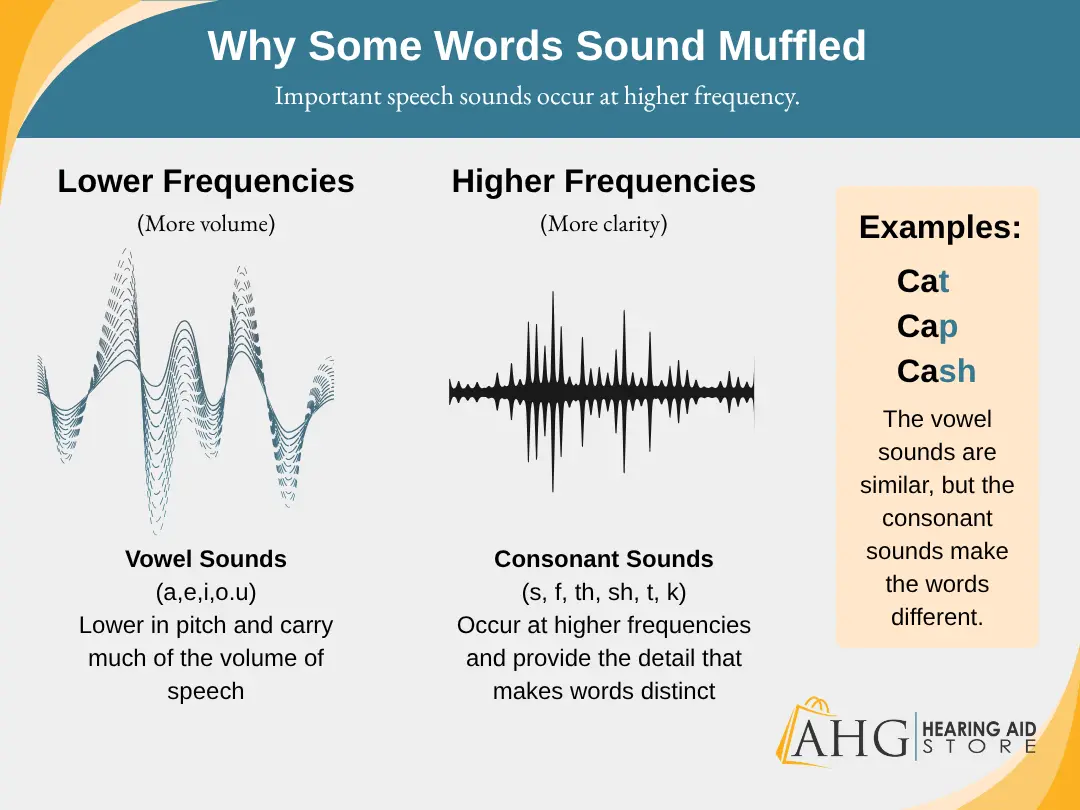
If your hearing aids aren’t providing sufficient amplification for those higher-frequency sounds, you may hear someone talking without clearly understanding their words.
Real ear measurements help your audiologist determine whether your hearing aids are providing appropriate access to these important speech frequencies.
This is particularly relevant if you frequently say, “I can hear you, but I can’t understand what you’re saying.”
Learn more about the relationship between hearing loss and speech clarity in our article, Why Can I Hear People Talking but Can’t Understand What They’re Saying?.
2. Whether Certain Sounds Are Being Amplified Too Much
More amplification doesn’t automatically mean better hearing.
If your hearing aids provide excessive amplification at certain frequencies, everyday sounds may become uncomfortable.
For example, you might notice that:
- Dishes clattering sound unusually harsh.
- Paper rustling seems excessively loud.
- Certain voices sound sharp or piercing.
- Louder environments become overwhelming.
Real ear measurements help your audiologist evaluate amplification at different input levels and identify areas where adjustments may be appropriate.
The goal is to provide enough amplification for useful sounds without unnecessarily increasing discomfort.
3. Whether Your Hearing Aids Match Your Prescribed Targets
Imagine that your hearing aid programming software indicates that your devices are providing the recommended amplification.
Everything looks correct on the computer screen.
However, when your audiologist performs real ear measurements, the results show that your hearing aids are delivering less amplification than expected at certain frequencies.
Without objective verification, that difference might go unnoticed.
With REM, your audiologist can identify the discrepancy and determine whether programming changes are needed.
This is one of the biggest advantages of real ear measurement hearing aid verification: it provides measurable information about actual sound delivery.
4. Whether Your Hearing Aid Settings Need Additional Fine-Tuning
Real ear measurements can also be useful after your initial hearing aid fitting.
Your hearing needs may change, or adjustments to your hearing aids may affect how sound reaches your eardrums.
For example, your audiologist may recommend additional verification if:
- Your hearing test results have changed.
- Your hearing aids have been significantly reprogrammed.
- You’ve switched to different earmolds or domes.
- You’re experiencing persistent difficulty hearing certain sounds.
- Your hearing aids aren’t providing the expected benefit.
REM provides objective information that can help guide additional adjustments when appropriate.
Real Ear Measurements vs. Hearing Aid Programming: What’s the Difference?
Although these procedures work together, hearing aid programming and real ear verification aren’t the same thing.
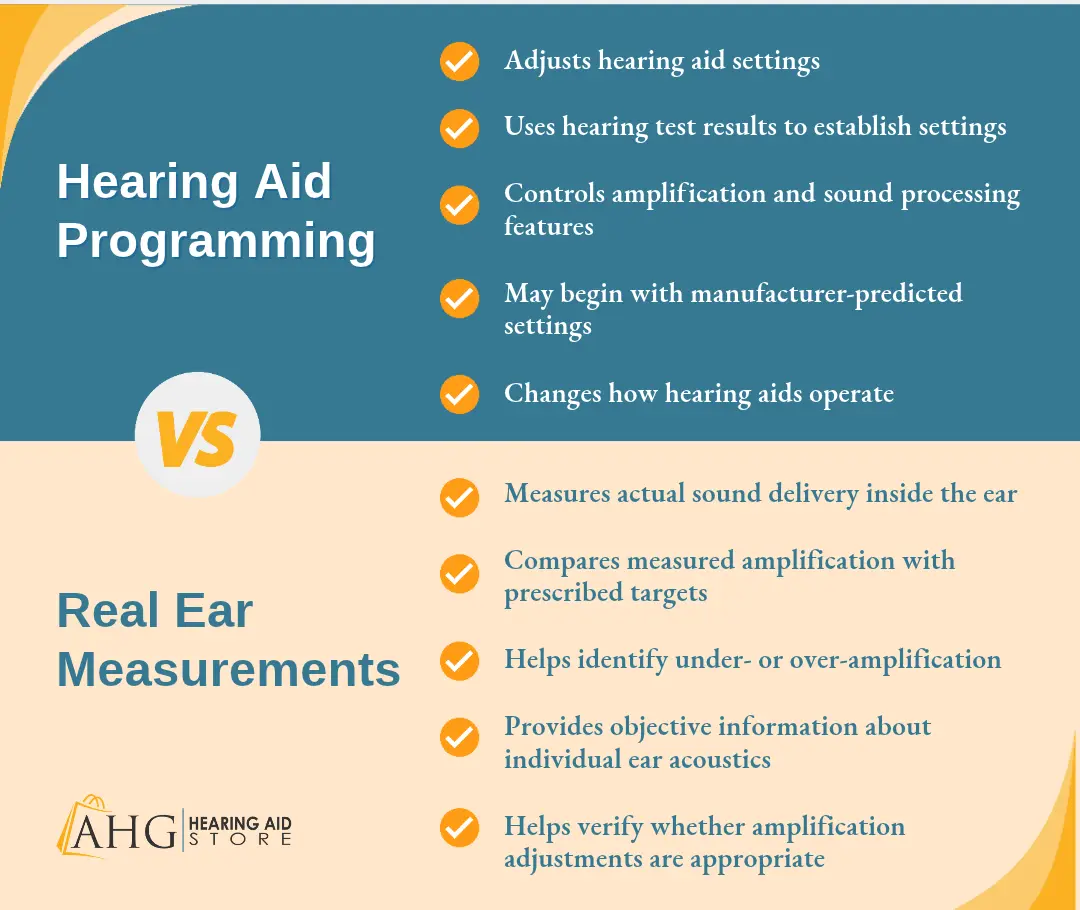
Think of programming as setting up your hearing aids and real ear measurements as checking whether those settings produce the intended results.
Both are valuable parts of a comprehensive professional hearing aid fitting.
Why Real Ear Measurements Matter When Comparing OTC vs. Professionally Fitted Hearing Aids
Over-the-counter hearing aids have made hearing technology more accessible to many adults.
FDA-regulated OTC hearing aids are intended for adults age 18 and older with perceived mild to moderate hearing loss. They can be purchased without a prescription, hearing test, or professional fitting.
Some OTC hearing aids offer smartphone-based hearing assessments, adjustable settings, and self-fitting technology that allows users to personalize amplification.
For certain adults with uncomplicated mild to moderate hearing loss, these devices may be a reasonable option.
However, self-adjusting hearing aids aren’t necessarily the same as professionally verified hearing aids.
One of the biggest differences is the level of individualized assessment, objective verification, and ongoing support available when working with an audiologist.
Learn more: OTC vs. Prescription Hearing Aids: A Complete Buyer’s Guide
OTC Hearing Aids May Offer Personalization, but Not Professional Verification
Many OTC devices allow users to adjust volume, sound balance, or other settings.
Some self-fitting models can also create individualized amplification settings through a smartphone app.
However, these adjustments generally don’t include professional probe microphone verification to confirm that amplification matches prescribed targets inside the user’s actual ear canals.
Without that measurement, users may not know whether their devices are providing appropriate amplification across important speech frequencies.
Professionally Fitted Hearing Aids Begin With a Comprehensive Evaluation
An audiologist evaluates more than whether you need sounds to be louder.
A comprehensive hearing assessment can help identify the type, degree, and configuration of hearing loss, as well as possible concerns requiring medical evaluation.
Your audiologist also considers your communication difficulties, lifestyle, preferences, and listening goals when recommending hearing technology.
This individualized approach can be especially valuable for people with more complex hearing needs.
Real Ear Measurements Add an Objective Layer of Personalization
With professional verification, your audiologist can measure actual amplification and make adjustments based on the results.
This helps ensure that your hearing aids are programmed according to your hearing prescription rather than relying solely on self-adjustments or manufacturer predictions.
Ongoing Audiology Support Helps Address Changing Needs
Another important advantage of working with an audiologist is having someone to turn to when your hearing aids need attention.
Hearing aid care doesn’t necessarily end when you leave your initial fitting appointment.
You may need help with:
- Hearing aid programming adjustments
- Changes in your hearing
- Physical fit and comfort
- Background noise difficulties
- Hearing aid maintenance and repairs
- Smartphone connectivity
- Follow-up verification when appropriate
Professional care provides access to guidance and troubleshooting that may not be included when purchasing OTC hearing aids independently.
It’s helpful to note that OTC hearing aids aren’t necessarily ineffective. The important distinction is that working with an audiologist provides access to clinical evaluation, verification, and individualized follow-up services that self-fitting alone doesn’t replace.
For individuals who want confidence that their hearing aids are appropriately selected, programmed, and verified, professional audiology care offers significant advantages.
Why Working With an Advanced Hearing Group Audiologist Makes a Difference
Choosing hearing aids is an important decision, but the devices themselves are only one part of successful hearing care.
At Advanced Hearing Group, our experienced audiologists provide personalized hearing healthcare for individuals in Mesa, Scottsdale, and surrounding Arizona communities.
Rather than treating hearing aids as a one-time purchase, the goal is to help you find technology that supports your hearing and communication needs over time.
Professional hearing care can include:
- Comprehensive hearing evaluations: Understanding your hearing abilities and identifying the most appropriate treatment options.
- Personalized hearing aid recommendations: Selecting devices based on your hearing loss, lifestyle, listening preferences, and budget.
- Professional programming and fitting: Adjusting hearing aids to your hearing prescription and ensuring a comfortable physical fit.
- Real ear measurement and verification: Using objective measurements, when performed, to evaluate whether hearing aids are delivering appropriate amplification.
- Ongoing adjustments and support: Helping you adapt to your devices, address listening challenges, and make changes when needed.
- Maintenance and troubleshooting: Identifying whether performance problems are related to programming, physical fit, device condition, or changes in hearing.
The advantage isn’t simply having access to advanced hearing aid technology. It’s having knowledgeable professionals who can help you use that technology effectively.
What if Your Hearing Aids Have Already Been Fitted but Don’t Sound Right?
If you already wear hearing aids and aren’t satisfied with their performance, it doesn’t necessarily mean you need to replace them.
Sometimes, the problem is related to programming.
Other times, the issue may involve earwax, a blocked hearing aid component, an improper fit, or changes in your hearing.
Real ear measurements can help your audiologist determine whether amplification is appropriate, but they are only one part of a complete hearing aid evaluation.
For example, if your hearing aids are providing the prescribed amplification but conversations still sound unclear, your audiologist may investigate other factors affecting speech understanding.
If you’re experiencing muffled speech, excessive loudness, or inconsistent sound quality, read Why Your Hearing Aids May Not Sound Right: Could Real Ear Measurement Help? for a closer look at possible causes and solutions.
You may also find our hearing aid maintenance guide helpful for keeping your devices in good condition.
Questions to Ask Your Audiologist About Hearing Aid Verification
If you’re considering new hearing aids or scheduling a follow-up appointment, asking the right questions can help you better understand your treatment.
Consider asking:
- Will real ear measurements be performed during my hearing aid fitting?
- How will you determine the appropriate amplification targets for my hearing loss?
- How will you verify that my hearing aids are delivering the intended amplification?
- Can my current hearing aids be evaluated using real ear measurements?
- What happens if my hearing aids don’t match the prescribed targets?
- Will I be able to schedule follow-up programming adjustments?
- How will we evaluate whether my hearing aids are helping me understand speech in everyday situations?
These questions can help you understand the services included in your hearing aid care and the role of professional verification.
Frequently Asked Questions About Real Ear Measurements
How do audiologists know if hearing aids are working properly?
Audiologists use several methods to evaluate hearing aid performance, including hearing tests, listening checks, device performance testing, real ear measurements, and patient feedback. Real ear measurements specifically help verify whether hearing aids are delivering appropriate amplification inside the ear canal.
Are real ear measurements necessary for hearing aids?
Real ear measurements are widely recommended as a best-practice method for verifying hearing aid fittings. Although hearing aids can be programmed without REM, objective verification helps determine whether actual amplification matches prescribed targets.
What happens if my hearing aids fail a real ear measurement test?
A hearing aid that doesn’t match its prescribed amplification targets isn’t necessarily defective. Your audiologist may be able to correct the difference through programming adjustments. In some cases, changes to the physical fit, hearing aid components, or device selection may be needed.
Can real ear measurements improve speech understanding?
Real ear measurements help audiologists verify that hearing aids provide appropriate amplification for important speech frequencies. This can improve access to speech sounds, but it doesn’t guarantee perfect speech understanding. Hearing loss severity, background noise, auditory processing, and other factors also affect communication.
Do OTC hearing aids use real ear measurements?
Most OTC hearing aids are designed for self-fitting or user adjustment and don’t include professional real ear measurement verification as part of the purchase. Some OTC devices offer personalized settings, and certain models may be evaluated by a hearing professional. Availability of professional support depends on the device and provider.
Can an audiologist perform real ear measurements on hearing aids I already own?
Often, yes. An audiologist may be able to measure the amplification delivered by existing hearing aids. However, the ability to reprogram them depends on the model, available software, and device compatibility. Contact your audiologist to ask whether your devices can be evaluated and adjusted.
Does real ear measurement hurt?
No. Real ear measurement is generally painless and noninvasive. A thin probe tube is placed inside your ear canal to measure sound near the eardrum. You may notice the tube, but most people tolerate the procedure comfortably.
How often should real ear measurements be performed?
Real ear verification is particularly valuable during the initial hearing aid fitting. Additional measurements may be recommended when hearing thresholds change, amplification settings are significantly adjusted, or physical components affecting sound delivery are changed.
Can real ear measurements guarantee that my hearing aids will work perfectly?
No. Real ear measurements verify amplification, but they cannot guarantee perfect hearing or speech understanding in every situation. A successful hearing aid experience also depends on appropriate technology, comfortable fit, individual hearing abilities, listening environments, and ongoing professional care.
Are professionally fitted hearing aids better than OTC hearing aids?
Professionally fitted hearing aids offer advantages such as comprehensive hearing evaluation, individualized programming, objective verification, and access to ongoing audiology support. OTC hearing aids can be helpful for some adults with perceived mild to moderate hearing loss, but professional care is especially valuable when hearing needs are complex or self-fitting results are unsatisfactory.
Make Sure Your Hearing Aids Are Working for You, Not Just Making Sounds Louder
Hearing aids are designed to improve your access to sound and help you communicate more effectively. But choosing the right devices is only the beginning.
Real ear measurements provide an objective way for audiologists to verify that your hearing aids are delivering amplification appropriate for your individual hearing needs.
Combined with comprehensive hearing testing, personalized programming, and ongoing follow-up care, this verification process can make an important difference in your hearing aid experience.
At Advanced Hearing Group, we believe that better hearing involves more than simply purchasing advanced technology. It also means having access to professional expertise and personalized care.
Whether you’re exploring hearing aids for the first time or want to improve the performance of your current devices, our audiologists can help you understand your options and determine which services are appropriate for your needs.
Ready to experience the advantages of professionally fitted hearing aids?
Schedule an appointment with an Advanced Hearing Group audiologist in Mesa or Scottsdale, AZ, to discuss your hearing needs, professional hearing aid fittings, and real ear measurement verification.
The best hearing aids aren’t simply the ones with the most advanced features. They’re the ones that are appropriately selected, fitted, and adjusted for YOU!