
Getting hearing aids is about much more than choosing a device and putting it in your ear. For hearing aids to provide the clearest, most comfortable listening experience possible, they need to be selected, programmed, fitted, and adjusted for your individual hearing needs.
That’s where a professional hearing aid fitting comes in.
If you’re preparing for your first hearing aid fitting appointment, you may be wondering what will happen, how your hearing aids will be programmed, and whether they’ll sound natural right away. Understanding the process beforehand can help you know what to expect and what questions to ask.
Below, we walk through the hearing aid fitting process step by step—from selecting the right technology to programming, verification, education, and follow-up care.
What Is a Hearing Aid Fitting?
A hearing aid fitting is the process of customizing hearing aids to your hearing loss, ears, communication needs, and lifestyle.
Modern hearing aids are sophisticated medical devices. They can be programmed to provide different amounts of amplification at different frequencies based on the results of your hearing evaluation. Depending on the technology, they may also include features designed to improve speech understanding, manage background noise, connect with smartphones, stream audio, or automatically adapt to different listening environments.
A professional fitting helps ensure all of these features are configured appropriately for you.
In other words, getting fitted for hearing aids isn’t a one-size-fits-all process. Two people could purchase the same hearing aid model but require very different programming based on their hearing test results and individual needs.
What Happens Before the Hearing Aid Fitting?
The process generally begins before your actual fitting appointment.
A comprehensive hearing test helps your audiologist determine the type and degree of hearing loss you have.
Your audiologist may evaluate factors such as:
- The softest sounds you can hear at different frequencies
- How well you understand speech
- How your hearing differs between your ears
- How well you understand speech at different listening levels
- Other factors affecting your communication needs
Your audiologist will also want to learn about your everyday life.
Do you frequently have conversations in noisy restaurants? Attend meetings? Watch television with family? Talk on the phone throughout the day? Enjoy concerts, theater, church services, or other group activities?
Understanding where you have difficulty hearing helps your audiologist recommend hearing technology that fits both your hearing loss and your lifestyle.
9 Steps to a Successful Hearing Aid Fitting
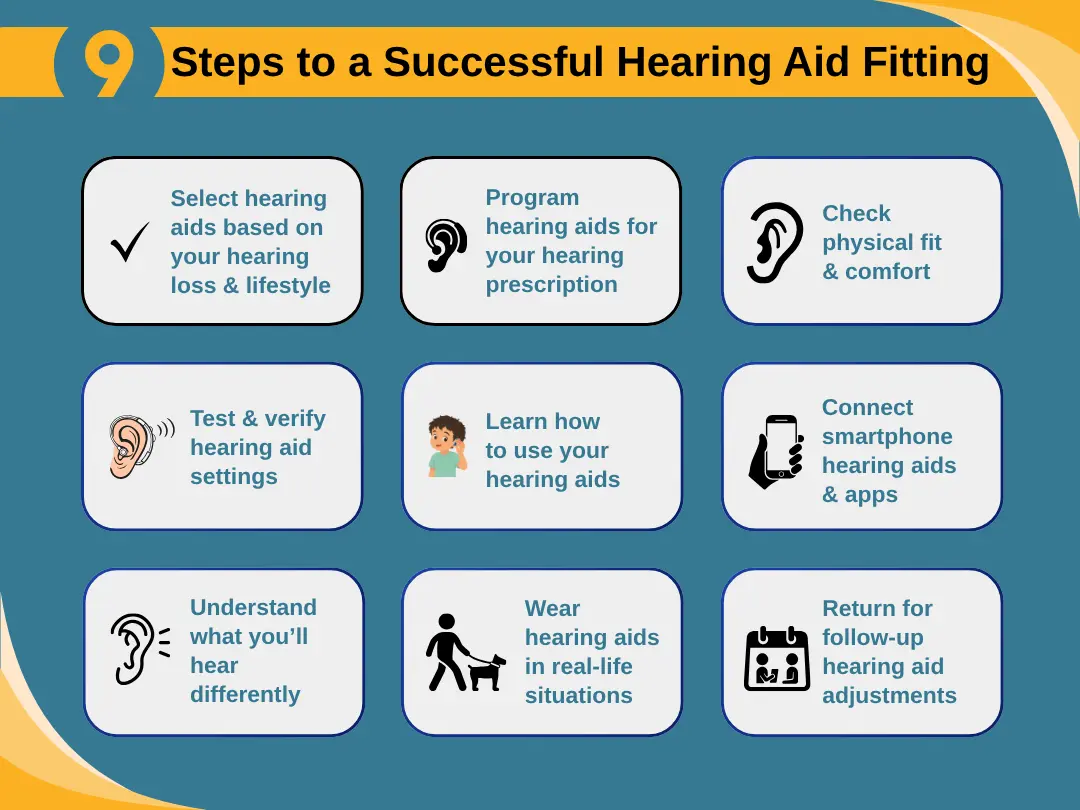
Step 1: Selecting Hearing Aids Based on Your Hearing Loss and Lifestyle
There are many different hearing aids available today, including different styles, technology levels, features, and price points.
Your audiologist can help you compare your options based on factors such as:
- Your type and degree of hearing loss
- The size and shape of your ears
- Dexterity and vision
- Cosmetic preferences
- Rechargeable versus disposable batteries
- Smartphone compatibility
- Bluetooth and audio-streaming preferences
- Your typical listening environments
- Your budget
Someone who spends most of the day having one-on-one conversations at home may have different technology needs than someone who regularly attends large meetings or frequently socializes in busy restaurants.
The goal isn’t necessarily to choose the hearing aid with the longest list of features. It’s to find technology appropriate for your hearing and communication needs.
Step 2: Programming Hearing Aids for Your Hearing Prescription
Once your hearing aids have been selected, they need to be programmed.
During hearing aid programming, specialized software allows your audiologist to adjust how the hearing aids respond across different frequencies and listening situations.
For example, your hearing test may show that you hear lower-frequency sounds relatively well but have significantly more difficulty hearing higher frequencies. Simply making every sound louder would not appropriately address that pattern.
Instead, modern hearing aids can be programmed to provide amplification according to your individual hearing needs.
Your audiologist may also configure features such as:
- Directional microphones
- Noise reduction
- Feedback management
- Speech-enhancement settings
- Automatic listening programs
- Manual programs for specific environments
- Bluetooth connectivity
- Tinnitus-related features when appropriate
Your initial programming provides a starting point. Fine-tuning can continue as you gain real-world experience with your hearing aids.
Step 3: Checking Physical Fit and Comfort
Hearing aids should also fit comfortably and securely.
During your hearing aid fitting appointment, your audiologist will check how the devices sit in or behind your ears. If your hearing aids use domes, earmolds, or custom earpieces, those components will also be evaluated.
A proper physical fit is important for several reasons. It can affect comfort, sound quality, retention, and the likelihood of acoustic feedback or whistling.
You may notice the hearing aids in your ears at first simply because they are new. However, they should not be painful.
Tell your audiologist if you experience uncomfortable pressure, soreness, slipping, or other problems. Small changes can sometimes make a significant difference in comfort.
Step 4: Testing and Verifying Your Hearing Aid Settings
One of the most important parts of a professional hearing aid fitting is verifying how the devices are performing.
It isn’t enough to program hearing aids based solely on manufacturer software and assume the settings are ideal. Audiologists can use verification techniques to evaluate how amplification is actually reaching your ears.
One commonly used method is real-ear measurement.
During real-ear measurements, a small probe microphone is placed in the ear canal along with the hearing aid. Measurements can then show how much sound is reaching the eardrum at different frequencies and input levels.
Your audiologist can compare those results with established fitting targets and make programming adjustments as necessary.
Verification helps turn hearing aid programming from an educated estimate into a more individualized, measurable process.
Step 5: Learning How to Use Your Hearing Aids
Your fitting appointment is also an educational appointment.
Before you leave, you should understand how to use and care for your new hearing aids.
Your audiologist may show you how to:
- Insert and remove the hearing aids
- Turn them on and off
- Charge them or replace batteries
- Adjust volume when appropriate
- Change listening programs
- Clean the devices
- Replace wax guards, domes, or other components
- Store the hearing aids safely
- Recognize common troubleshooting issues
Don’t worry if you don’t remember everything immediately. Using hearing aids involves learning some new routines, and those routines usually become easier with practice.
Step 6: Connecting Smartphone Hearing Aids and Apps
Many modern smartphone hearing aids can connect with compatible phones and mobile apps.
Depending on your hearing aid model and smartphone, connectivity may allow you to:
- Adjust volume
- Change listening programs
- Check battery levels
- Stream phone calls
- Stream music, podcasts, or other audio
- Adjust certain sound preferences
- Locate misplaced hearing aids
- Access remote support features when available
Your audiologist can help pair compatible hearing aids with your smartphone and explain which app features are useful for your particular devices.
If smartphone connectivity is important to you, mention it when discussing hearing aid options rather than waiting until the fitting appointment.
Step 7: Understanding What You’ll Hear Differently at First
One of the biggest surprises for some new hearing aid wearers is just how many sounds they begin noticing again.
You might suddenly become more aware of sounds such as:
- Paper rustling
- Water running
- Dishes clinking
- Your footsteps
- Turn signals
- Birds
- Clothing moving
- Your keyboard
- Your own voice
Some of these sounds may initially seem unusually noticeable.
Why?
When hearing loss develops gradually, the brain may receive less information from certain sounds for months or years. Restoring access to those sounds can require an adjustment period.
This is one reason expectations are an important part of the hearing aid fitting process.
Your hearing aids should help improve access to sounds and speech, but your brain also needs time to become accustomed to the additional auditory information.
Related article: Living with Hearing Aids: A Life-Changing Experience
Step 8: Wearing Your Hearing Aids in Real-Life Situations
Your first fitting is not the end of the process.
After your appointment, you’ll begin using your hearing aids in the situations that matter most—at home, at work, in restaurants, in the car, during family gatherings, and everywhere else you communicate.

Pay attention to what works well and what doesn’t.
For example:
- Are voices clear but slightly too sharp?
- Is your own voice distracting?
- Are certain environments still particularly difficult?
- Is one hearing aid more comfortable than the other?
- Are soft sounds audible without louder sounds becoming uncomfortable?
- Are you having difficulty using a specific feature?
Specific feedback gives your audiologist useful information for future adjustments.
Step 9: Returning for Follow-Up Hearing Aid Adjustments
Follow-up care is an important part of successful hearing aid use.
At follow-up appointments, your audiologist can discuss your experiences and make adjustments based on the situations you’ve encountered.
This may include changing:
- Overall amplification
- Frequency-specific settings
- Noise-management features
- Microphone settings
- Individual listening programs
- Physical fit
Follow-up appointments are also an opportunity to review cleaning and maintenance, troubleshoot connectivity problems, or ask questions that came up after your initial fitting.
Some people need relatively few adjustments, while others benefit from several rounds of fine-tuning.
The goal is to optimize your hearing aids based not only on test results but also on your experiences in the real world.
Hearing Aid Fitting and Aural Rehabilitation
Hearing technology is only one part of improving communication.
For some individuals, aural rehabilitation can complement hearing aid use by addressing listening and communication strategies.
Aural rehabilitation may involve learning ways to make conversations easier, improving listening strategies, understanding how environmental factors affect communication, and helping family members communicate more effectively.
This can be especially useful because hearing aids improve access to sound, but they cannot eliminate every communication challenge associated with hearing loss.
Questions to Ask Your Audiologist at a Hearing Aid Fitting
Your fitting appointment is a good opportunity to ask questions. Consider asking:
- How were my hearing aids programmed for my hearing loss?
- How do I know if my hearing aids are fitting properly?
- Were my hearing aid settings verified?
- How many hours per day should I wear my hearing aids?
- What sounds might seem unusual at first?
- What should I do if sounds seem too loud or too soft?
- How do I clean my hearing aids?
- How often should I replace wax guards or other components?
- What should I do if my hearing aid stops working?
- How do I connect my hearing aids to my smartphone?
- When should I return for a follow-up adjustment?
- How often should my hearing and hearing aids be rechecked?
Write down additional questions before your appointment so you don’t forget them.
FAQs About Hearing Aid Fittings
How long does a hearing aid fitting appointment take?
Appointment length can vary depending on the hearing aids, the amount of programming required, verification procedures, and how much instruction is needed. Your audiologist’s office can tell you how much time to allow for your particular appointment.
Should hearing aids sound natural immediately?
Not necessarily. Some sounds may initially seem different or more noticeable because you’re receiving auditory information that you may not have heard clearly for some time. Your perception of sound can change as you become accustomed to wearing hearing aids, and follow-up adjustments can address specific concerns.
Are hearing aids supposed to feel uncomfortable at first?
You may be aware of having something in or around your ears when you first begin wearing hearing aids, but the devices shouldn’t hurt. Let your audiologist know about soreness, excessive pressure, or persistent irritation.
How often will my hearing aids need adjustments?
There is no universal schedule that works for everyone. You may need adjustments during the initial adaptation period and later if your hearing, listening needs, or preferences change.
What is real-ear measurement during a hearing aid fitting?
Real-ear measurement is a verification procedure used to measure how hearing aids are delivering sound in an individual’s ear canal. It helps an audiologist determine whether amplification is appropriately matching fitting targets and make adjustments when necessary.
Can I get hearing aids without a professional fitting?
Hearing devices are available through different channels, but a professional fitting offers individualized assessment, programming, verification, physical-fit evaluation, education, and follow-up care. These services can be especially important for making sure hearing aids are appropriately configured for your hearing needs.
Related article: Should I Go to An Audiologist for Hearing Aids?
Should I bring my smartphone to my hearing aid fitting?
Yes, particularly if your hearing aids offer smartphone connectivity. Having your phone with you allows your audiologist to help with pairing, apps, streaming, and other compatible features.
What if I don’t like how my hearing aids sound?
Tell your audiologist what you’re experiencing. Details such as which sounds are bothersome, where the problem occurs, and whether it affects one or both ears can help guide adjustments.
A Hearing Aid Fitting Is the Beginning, Not the End
A successful hearing aid fitting combines technology with professional expertise and individualized care.
Your hearing aids need to be selected for your needs, programmed according to your hearing, checked for comfort, verified, and fine-tuned based on your real-world experiences. Just as importantly, you need to understand how to use them confidently.
That’s why ongoing care can be just as important as the devices themselves.
At Advanced Hearing Group, our audiologists work with you throughout the process—from comprehensive hearing testing and hearing aid selection to professional fitting, programming, and follow-up adjustments.
Ready to Hear What Professionally Fitted Hearing Aids Can Do?
Are you ready to experience professionally fitted hearing aids? Schedule an appointment with an Advanced Hearing Group audiologist in Mesa or Scottsdale, AZ.
Whether you’re considering hearing aids for the first time or want professional guidance with your current devices, we’re here to help you find solutions designed around your hearing and communication needs.